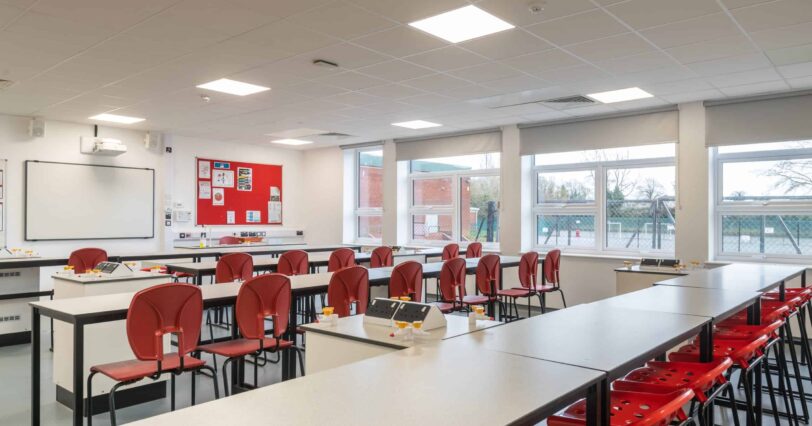


As the government increases its focus on integrating SEND provision within mainstream education, inclusion bases are becoming an increasingly prominent feature of UK schools. Now encouraged through SEND reform and policy discussions, these are typically understood as dedicated spaces for pupils to access specialised support. As local authorities begin allocating targeted SEND capital funding, the sector could be entering a defining period of change.
Those that align with this shift and start preparing now for the rollout of inclusion bases, will be able to see the benefits first hand. By familiarising themselves with available guidance, working collaboratively and utilising modern construction methods, schools can begin moving towards more inclusive estates in a new phase of SEND reform.
Understanding design standards
Getting ahead of the guidance and reviewing the available design standards will help to create inclusion bases that improve learning experiences for students. Existing DfE guidance includes Building Bulletin 93 on acoustic design and Building Bulletin 104 on spatial standards. These provide a clearer framework outlining how factors such as acoustics, lighting, ventilation and adjustability, can be tailored to SEND needs. For example, by installing design features such as acoustic panels and soft furnishings to absorb sound, schools can reduce echo and mitigate sensory overload, helping to enhance concentration in inclusion bases.
While many schools may already have dedicated spaces for specialist or SEND support in place, these are typically used when teachers are reacting to student behaviour in the main classroom setting, for example, removing a student to address behavioural issues or overstimulation. Inclusion bases, however, reflect a more proactive approach to SEND provision and can optimise students’ learning experiences from day one, especially when created with modern design standards in mind.
Integrating inclusion bases
Schools and estates managers should also consider how inclusion bases will fit into the wider estate. It’s important for these spaces to be well-integrated, preventing the risk of further isolation of SEND pupils. Ensuring access to shared facilities like the main playground, for example, can address this, along with fluid timetabling built into everyday school routines.
While part of a key government focus to drive SEND reform, inclusion bases do not necessarily need to be reserved solely for students with formal diagnoses. Adopting a flexible approach can add more value to estates; for example, school leaders could utilise inclusion bases to also accommodate students with additional learning requirements, emotional needs and support during difficult circumstances outside of school.
Unlocking value with MMC
Modern methods of construction (MMC) and modular solutions are likely to play a key role in the successful delivery of inclusion bases. MMC utilises precise manufacturing methods which accelerates build times, minimises delays and supports improved consistency and quality control. This can allow inclusion bases to go beyond baseline compliance standards as they are delivered, integrating manufacturing processes and high-quality design that will optimise learning environments.
Modular buildings can also be repurposed and reconfigured according to school requirements and student numbers, which remain unpredictable by nature. Within SEND itself, needs span from speech and language support, to sensory provision and behavioural solutions, so adaptable spaces are a requirement to ensure schools can meet pupils’ needs. Fixed, permanent buildings are typically less adaptable to evolving requirements and can be a significant financial outlay. Modular solutions, on the other hand, are often a more cost-effective option for schools looking to improve SEND provision without restricting the flexibility of their estate.
Prioritising collaboration
As well as effective design and construction methods, a collaborative approach to implementing inclusion bases will also be essential for success. School leadership teams, estates managers and local authorities should work closely, all recognising their responsibility in delivering inclusion bases and contributing their unique expertise.
School leadership teams, for example, understand considerations around curriculum delivery and operational pressures, while estates managers can focus on physical design and how inclusion bases will fit into the wider site. This, connected by funding priorities and regional insights from local authorities, can shape an intentional, impactful strategy for the implementation of inclusion bases.
As SEND reform progresses, inclusion bases are set to be far more than simply another trend in education design. They represent a wider shift across the sector, and an opportunity for schools and estates managers to rethink how they approach SEND provision. The schools that familiarise themselves with the design guidance, implement strategically, leverage the benefits of MMC and prioritise collaboration, will be better prepared to address evolving SEND needs as inclusion bases are delivered across mainstream education.
Want to find out more about how MMC can deliver adaptable, future-proofed estates for colleges? Contact the team here.